
Why South Africans Should
Choose Locally Grown Garlic
Executive summary
South Africa still relies heavily on imported garlic. Fresh garlic imports were 3.02 million kg in 2022, 2.99 million kg in 2023 and 3.30 million kg in 2024, worth US$8.56 million in 2024 alone. In 2024 the main source countries were China, India, Malaysia, Spain and Vietnam. Against that backdrop, choosing South African garlic is not only a quality decision; it is a practical one for households, restaurants, retailers and processors that want fresher product, stronger traceability and a more resilient local food system. [1]
Why local garlic matters
Locally grown garlic can reach buyers with fewer transport and storage steps. That matters because garlic quality changes during storage: peer-reviewed studies show storage conditions affect firmness, aroma, volatile compounds and organosulfur chemistry, while postharvest guidance notes garlic may be held for more than nine months under controlled conditions. In practice, shorter supply chains usually mean a better chance of buying firmer, more aromatic bulbs with less time spent in long cold storage. [2]
Local sourcing also strengthens traceability and food safety oversight. South African buyers can usually verify farm origin and handling more directly, while scientific reviews show traceability systems improve confidence, recalls and quality control in fresh produce.
For imported garlic, South Africa requires phytosanitary compliance and, where applicable, import permits through the National Plant Protection Organisation of South Africa. [3]
Economically, buying local supports South African growers and the domestic value chain. DALRRD identifies high-quality production zones in Limpopo, North West, Gauteng, parts of the Free State, KwaZulu-Natal, the Karoo in the Western Cape and parts of the Northern Cape. Yet the latest publicly accessible detailed official production series reviewed runs to 2020, not 2024, so a newer official production tonnage is unspecified in the public sources reviewed. [4]
South African market snapshot
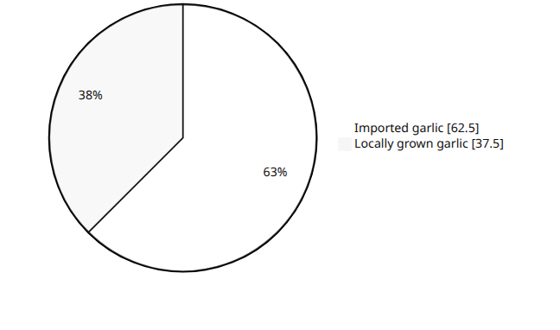
The best public estimate of South Africa’s supply split that I could verify is from the National Agricultural Marketing Council: garlic consumption was about 4,800 tonnes a year, with imports around 3,000 tonnes, implying roughly 62.5% imported and 37.5% local. This older estimate usefully illustrates why expanding domestic production matters. [5]

Flowchart note: simplified comparison of typical routes; imported consignments face additional cross-border compliance and logistics steps. [6]
Approximate split of South African garlic supply
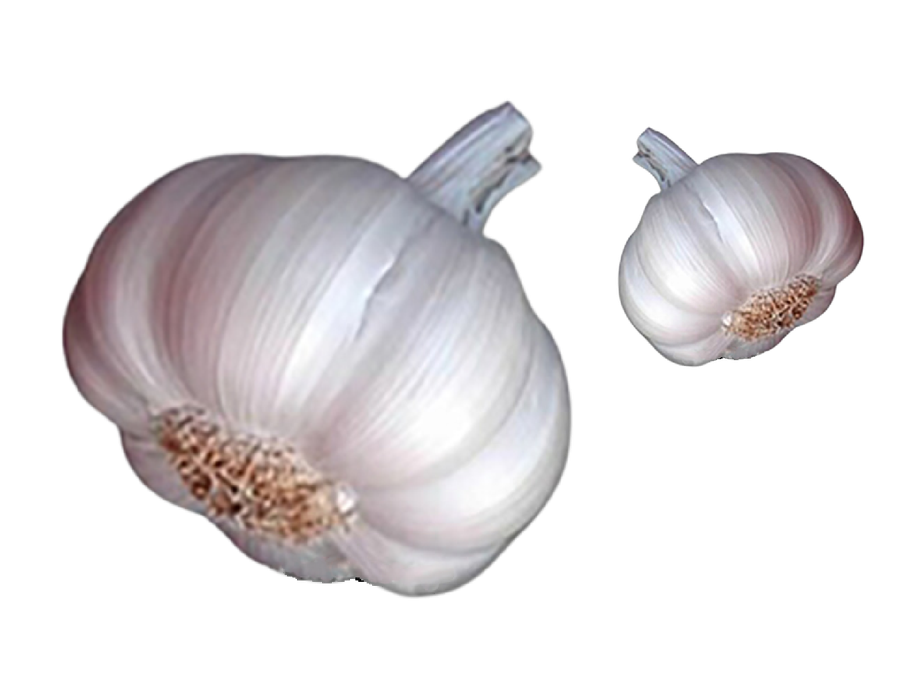
Local and imported garlic at a glance
Policy and trade context
South Africa’s 2026 customs schedule lists a general customs duty of 325c/kg, capped at 37%, on fresh garlic under HS 0703.20. Garlic from China also remains subject to an anti-dumping duty of 1 925c/kg, following ITAC’s sunset review and the current SARS Schedule 2. Imported plants and plant products must meet phytosanitary requirements under the Agricultural Pests Act and, where required, hold an import permit. Recent shipping disruptions around the Red Sea and congestion at South African ports have underlined the vulnerability of long import chains. [8]
Meta description and
priority sources
Suggested meta description: Why South African garlic matters: fresher flavour, stronger traceability, local jobs, lower supply risk and less dependence on imports.
Priority sources
- DALRRD, Garlic Commodity Profile 2021 — official overview of South African production areas, market structure, production trend and import dependence. [9]
- World Bank WITS using UN Comtrade data — the clearest recent source for South Africa’s garlic import quantities, values and source countries in 2022–2024. [10]
- SARS Tariff Book and Schedule 2 — current customs duty and anti-dumping duty applicable to imported garlic. [11]
- Gov.za / NPPOZA import permit guidance — official phytosanitary and import-permit requirements for plant products entering South Africa. [12]
- NAMC report, plus peer-reviewed studies in Nature Food and Scientia Horticulturae — background on South African garlic consumption/import share, food-miles impacts and the effect of storage on garlic quality. [13]
Sources
[1] [10] Garlic, fresh or chilled imports by country |2022
https://wits.worldbank.org/trade/comtrade/en/country/ALL/year/2022/tradeflow/Imports/partner/WLD/product/070320
[2] A comprehensive review on impact of post-harvest …
https://www.sciencedirect.com/science/article/abs/pii/S0304423824007404
[3] Food Traceability: A Consumer-Centric Supply Chain … – PMC
https://pmc.ncbi.nlm.nih.gov/articles/PMC7999538/
[4] [6] [9] GARLIC COMMODITY PROFILE
https://www.nda.gov.za/images/Branches/Economica Development Trade and Marketing/marketing/annual-publications/vegetables/garlic-market-value-chain-profile-2021.pdf
[5] [7] [13] namc.co.za
https://www.namc.co.za/wp-content/uploads/2021/01/Market-Intelligence-Report-Week-48-of-2020.pdf
[8] [11] 2026-07-24 SCHEDULE 1 / PART 1 Customs & Excise Tariff
https://www.sars.gov.za/wp-content/uploads/Legal/SCEA1964/Legal-LPrim-CE-Sch1P1Chpt1-to-99-Schedule-No-1-Part-1-Chapters-1-to-99.pdf
[12] Apply for a plant import permit
https://www.gov.za/services/export-permits-import/phytosanitary-permit
Information on the Voluntary Levy
The South-African Garlic Growers Association is currently funded through a Voluntary Levy of 0,5% on the Gross sales of garlic at any Agent on the National Fresh Produce Markets.
The money is levied by the Sales agent on the floor and is then paid over to the organization by the Market Authority. It is a voluntary levy and if anybody selling garlic on the National Fresh Produce Markets feels that he doesn’t want to fund the organization, he can do so in writing to his Sales Agent who will convey the information to the Executive of SAGGA. The Executive of SAGGA will contact the person to do a follow-up.